


> Home > What to visit > Castles

Castello di Brolio Gaiole in Chianti
CASTLES
PHONE NUMBERS AND TIMES
Castello di Brolio
Località Brolio, 53013 Gaiole In Chianti
Website: http://www.ricasoli.it/
Business card (vCard)
.jpg)
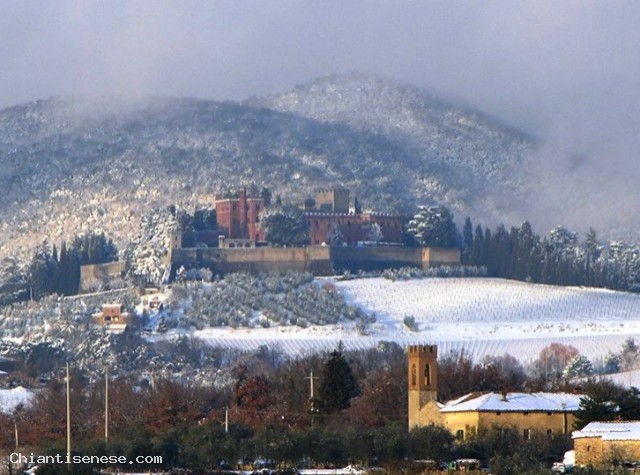
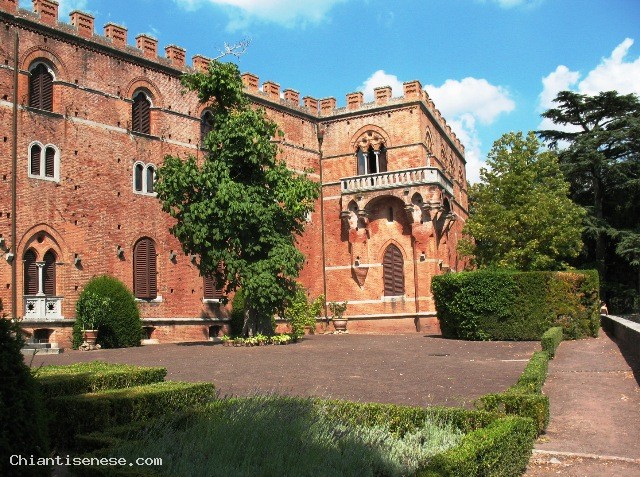
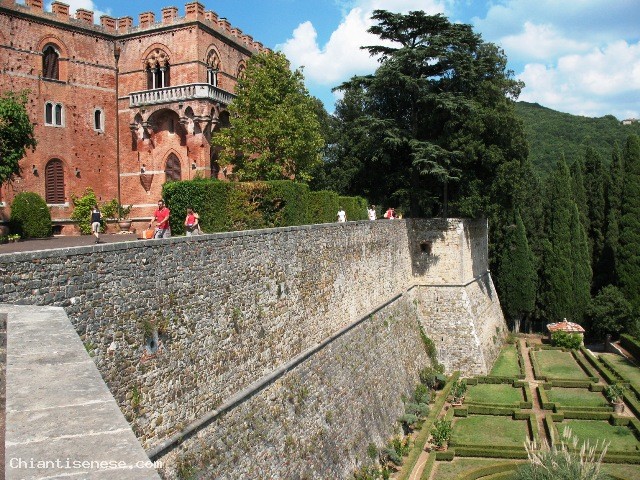
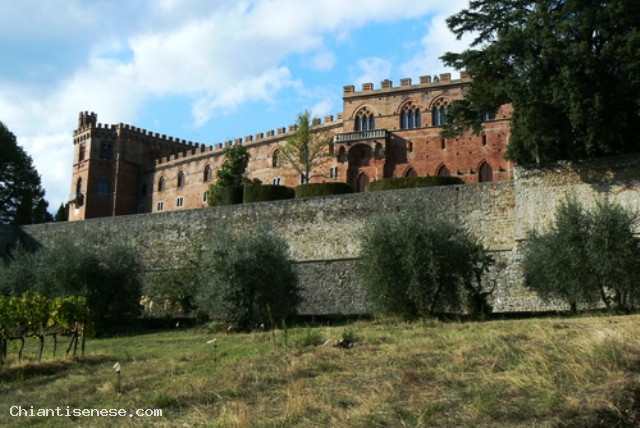
The toponym "Brolio," derived from the Lombard term "Brolo," with its transalpine name harks back to a time before the year 1000, when Broilo or Brolio was designated "a wooded estate with a fenced enclosure reduced to a domestic setting, and in the middle of it a castle for the residence of its lord."
From some documents dating back to the 10th century, it appears that the lord of the castle of Brolio and its district was a Marquis Bonifazio, son of Count Alberto, who in 1009 donated to the Abbey of Florence, among his other courts, that of Brolio, along with the ownership of the parish church of San Regolo. This donation was later confirmed to the Abbey by Emperor Henry II in 1012 and by Henry IV in 1074.
Later, the territory and castle of Brolio became the property of the noble Florentine Ricasoli family.
Becoming part of Florentine territory coincided with the massive fortification of the castle, which was equipped with bastions and watchtowers. Brolio was, in fact, the last outpost of the Florentine Republic on the Florentine-Sienese border, and therefore a sensitive position in the Chianti military arena, so much so that the castle was the victim of numerous attacks.
In 1252, it was attacked and captured by the Sienese and returned to the Ricasoli family only the following year after the signing of the armistice between Florence and Siena. Again in 1434, Antonio Petrucci of Siena entered the area by deception and took the Ricasoli family prisoner until the Signoria of Florence sent Neri Capponi to their aid, who, with his men, forced Petrucci to surrender. Then, in 1452, the Aragonese, allies of Siena, besieged Brolio and Cacchiano but failed to capture them.
The Sienese attack of August 27, 1478, was far more devastating, having been furiously carried out with bombardments. Although Florence had sent Anghiarino, a skilled strategist and captain of fortune, to lead the defense of the castle, under Sienese mortar fire, part of the walls collapsed, and the situation became dire.
Then Bongianni Gianfigliazzi, from the Valdarno, gathered an army and marched toward Chianti in an attempt to bring relief to the besieged, but before he could do so, Brolio surrendered to the enemy.
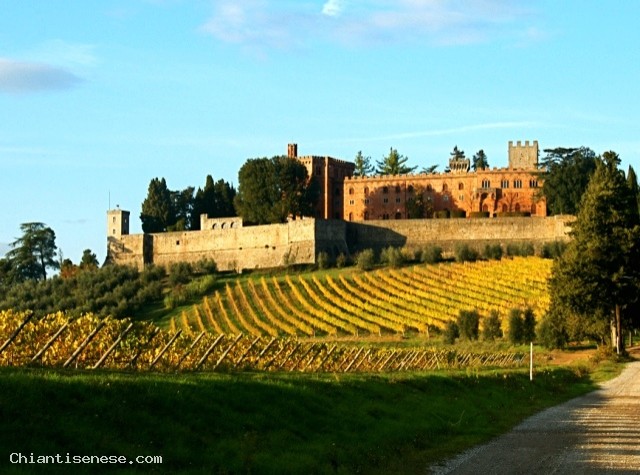
After the Florentine conquest of Siena, Brolio was converted, according to a design by Giuliano da Sangallo, into a prestigious noble residence and an impressive agricultural and, above all, winemaking estate.
In this regard, although documents from the early 2000s attest to the widespread cultivation of vines in Brolio by that time, a notarial deed from 1696 insured a shipment of fine wines departing from the port of Livorno bound for Amsterdam. And again, in 1722, the Duke of Norfolk wrote to a Brolio representative in London to secure monthly delivery of "fifty or more cases of Brolio's true Chianti."
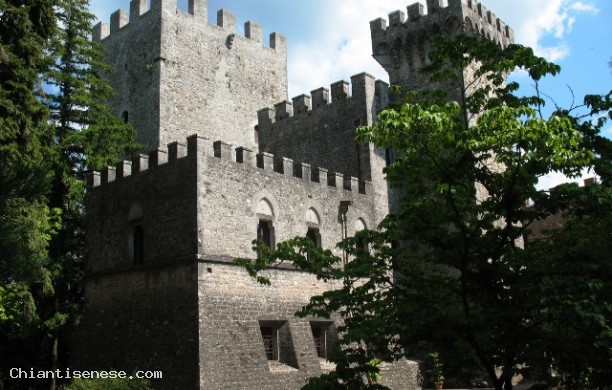
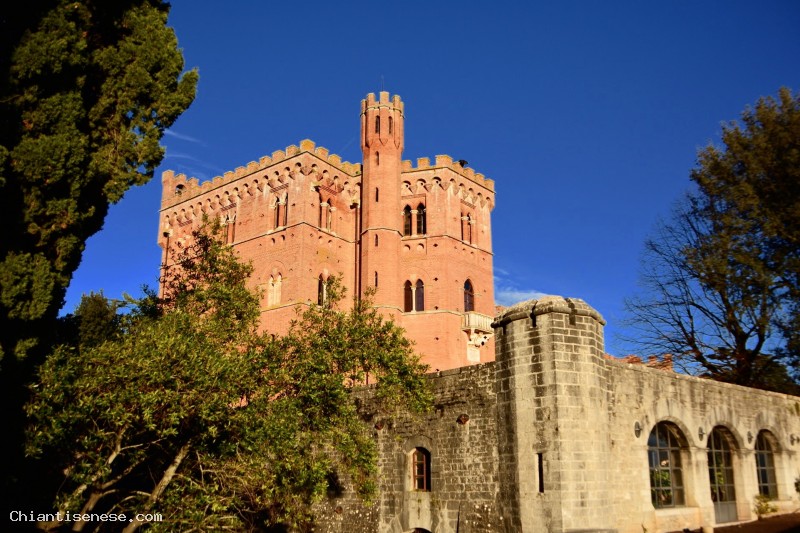
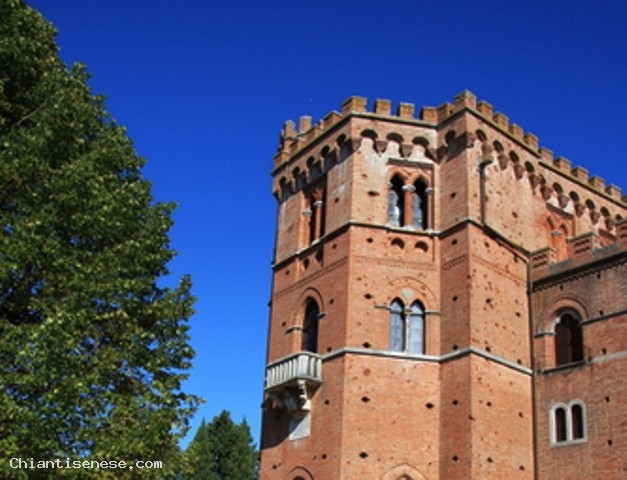
In 1829, Bettino Ricasoli began personally managing the Brolio estate, and throughout his life he alternated political commitments with in-depth studies in viticulture. The Iron Baron paid particular attention to the grape varieties best suited to the ideal wine he wanted to produce on his lands. A variety of grapes were grown at Brolio, from Pinot to Cabernet, from Grenache to Carignano, but the ones that produced the best results for Bettino Ricasoli were undoubtedly the clones of Sangiovese di Brolio, a variety still present in the estate's vineyards today because subsequent replantings have almost always used native plant material. This brings us to 1874 when Baron Bettino, after years of research and experimentation, defined the blend for Chianti Classico, which, almost a century later, inspired the production regulations for Italy's most famous wine, which remain in force to this day. In 1835, Baron Bettino Ricasoli commissioned architect Pietro Marchetti to remodel the castle in the Gothic Revival style, a Romantic movement originating in England. It was transformed from an ancient fortress into an English manor, using brick as the primary material, adding Tudor-style windows and crenellated turrets unfamiliar with local architecture. Of the castle itself, only the base of the keep, dating back to the early 1100s, is recognizable as original, while the well-preserved walls are typical of medieval Renaissance architecture. The different eras are easily distinguishable thanks to the different use of the ancient building materials, pietra serena, and brick. Brolio's landscaped gardens, as well as the architecture of the complex, distinguish two distinct periods: the 16th-century Italian garden, with box hedges and paths, and the 19th-century romantic park, commissioned by botanist Simone Ricasoli. He had various imported botanical species planted around the castle, including some fir trees that today have reached a height of 30-40 metres.
STAY NEARBY
VILLA LA GROTTA
GAIOLE IN CHIANTI
...I COLLI E AGRESTO
GAIOLE IN CHIANTI
...IL CAMPUCCIO DI SAN REGOLO
GAIOLE IN CHIANTI
...DINING & ENTERTAINMENT NEARBY
Teatro Vittorio Alfieri
CASTELNUOVO BERARDENGA
Il Teatro Vittorio Alfieri è un teatro situato a Castelnuovo Berardenga. Il teatro...La Perla Del Palazzo
RADDA IN CHIANTI
...Al Chiasso Dei Portici
RADDA IN CHIANTI
...